Greetings from this side of the autumnal equinox! I hope that your gardens are feeling some relief from this summer’s scorching temperatures, although more rains would be appreciated right now. With cooler days now in-hand, I find my mind drifting forward to the upcoming winter season, and specifically our Magic Christmas in Lights upcoming season – our 28th annual!
We are so looking forward to having you join us, but today I want to exhort you to come early for our “A Starry Night Preview Gala.” This will be our fourth preview party for our winter lights season. Please savethedate and mark your calendars for November 23, 2024 (Thursday) from 6:30 through 9:30 pm. We will have special hors d’oeuvres, wonderful drinks and a specially themed cocktail, and live music courtesy of the Symone French Trio! Cocktail attire is desired. Tickets will go on sale starting on October 13 – Friday the 13th – and will be $75 per person.
We are also reaching out to local businesses who are interested in sponsorships for this year’s Magic Christmas in Lights. We already have a special, anonymous $15,000 sponsor lined up, and we invite you to join and help Bellingrath Gardens & Home continue to move forward and excel!
Thank you. We so look forward to seeing you at this year’s Magic Christmas in Lights 2023!
As September comes to a close, residents along the Gulf Coast sigh in relief if the area has not been visited by a hurricane. Mobile has been hit hard by September hurricanes with the two worst being in 1979 and 1906.
The 1906 storm was Walter Bellingrath’s first. He had been in town barely three years when it hit the area hard, killing an estimated 150 in Mobile County. Long before the advent of radar and countless “Weather Alerts” residents along the Gulf Coast were often surprised by the unwelcome arrival of a hurricane.
In late September of 1906 there had been news of a hurricane entering the Gulf of Mexico, but the slim accounts offered little help as to where it would hit. The closest guess was from the western coast of Florida to New Orleans. Skies were overcast in Mobile on September 25 and as the day progressed so did the amount of rain. Telephone service and electricity were knocked out by 9:00 PM. The next day the winds picked up rapidly, knocking down church steeples and sending statuary atop the Mobile County Courthouse crashing to the street and the storm only worsened that night.
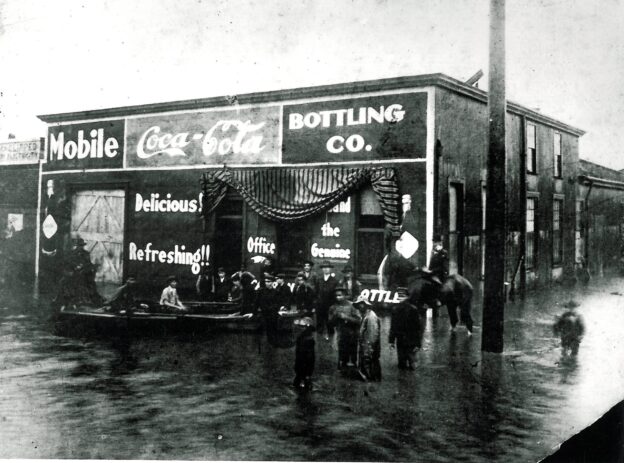
On the night of September 27, two days of heavy rain joined a high tide resulting in heavy flooding. Water rushed several blocks into downtown Mobile bringing an assortment of debris and a few riverboats. Walter Bellingrath found his modest Coca-Cola plant on Water Street waist deep in water. In a letter to his mother, he described watching helplessly as countless wooden crates for his bottles were washed out into the Mobile River. Discouraged he wrote, “I feel just like a modern day Jonah.”
Thankfully, Walter Bellingrath started over and just two months later married Bessie Morse. The couple would go on to survive other hurricanes together, none of which would equal the storm of 1906.
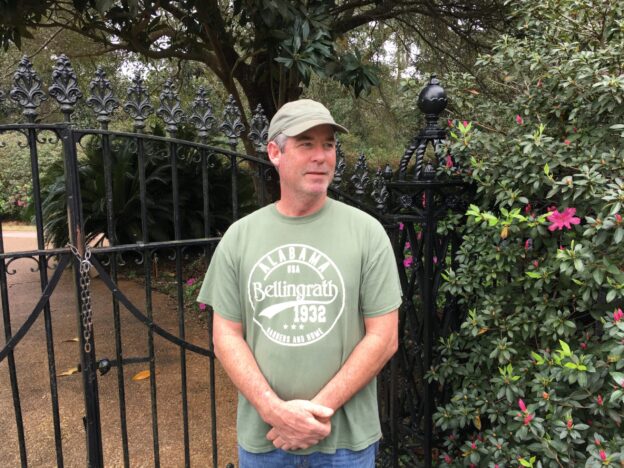
Bellingrath Gardens & Home is delighted to introduce its newest addition to the team, Jeremy A. Schmidt, who assumed the role of Director of Horticulture on August 31, 2023. With a passion for creating awe-inspiring outdoor spaces that foster a deep connection to nature, Jeremy brings a visionary perspective to one of the region’s most cherished botanical treasures.
Jeremy A. Schmidt joins Bellingrath Gardens & Home after spending an impressive 15 years immersed in one of the world’s largest collections of captivating plants at Plant Delights Nursery/Juniper Level Botanic Garden, where he served as the Research and Grounds Supervisor. His extensive expertise in horticultural art and infrastructure will enhance Bellingrath Gardens & Home’s already renowned outdoor spaces.
What makes Jeremy’s arrival especially exciting is his commitment to innovative horticultural practices. He’s known for pioneering techniques like combatting compaction with compaction, pushing the boundaries of what’s possible in the world of gardening. Jeremy has even stacked over 3 million pounds of stone to promote botanical diversity—an extraordinary feat that exemplifies his dedication to transforming landscapes.
Furthermore, Jeremy brings valuable research experience to Bellingrath Gardens & Home. His work with native Trillium populations and their cultivation in the garden will undoubtedly contribute to the garden’s ongoing growth and success. “We are tremendously excited to have someone of Jeremy’s stature join the horticulture team as our new Director of Horticulture at Bellingrath Gardens & Home. Jeremy is a brilliant plantsman, stone expert and artisan, and passionate horticulturist,” says F. Todd Lasseigne, Executive Director.
Jeremy himself is eager to embark on this new journey at Bellingrath. “I am excited to stand alongside my fellow BGH team members as we cultivate a foundational atmosphere of intense connection and excitement for our guests, positioning BGH as a world-class example of imaginative botanical display and anthropocentric land stewardship,” says Jeremy A. Schmidt. “Then let’s see where we can go from there!”
As Bellingrath Gardens & Home continues to evolve and innovate, Jeremy A. Schmidt’s visionary leadership promises to take this iconic garden to even greater heights. Stay tuned for exciting developments and inspiring transformations as we embark on this botanical adventure together.
One of my two major professors back in my NC State University days, Dr. Stu Warren, was fond of saying “Progress is being made” whenever I’d go and update him on my dissertation research projects. That was a nice way of encouraging me to keep plodding along with the seemingly never-ending task of completing a doctoral research program and dissertation. Stu was an inspiration, and a great Ph.D. advisor.
Here at Bellingrath, the same can be said – Progress is being made. It is sometimes slower than desired. It oftentimes comes with unexpected obstacles on the path. It sometimes seems like a set of tasks that will never be completed. The extreme (record) heat of August didn’t help, either, right?!
With the recent hiring of Jeremy Schmidt as our new Director of Horticulture, Bellingrath finds itself ready to move to the proverbial next level. We are talking about our soils. We are talking about stones. (Jeremy is an expert in a new style of building rock gardens called “crevice gardens.”) Of course, too, we are talking about plants! We are talking about equipment, staff, the need for additional staffing, infrastructure, facilities, etc.
We plan on continuing to capitalize on the improvements that we have made over the past three years – new equipment, renovated garden spaces, new plantings, our new brand – and we ask you to just keeping enjoying the show and supporting us in the path ahead!
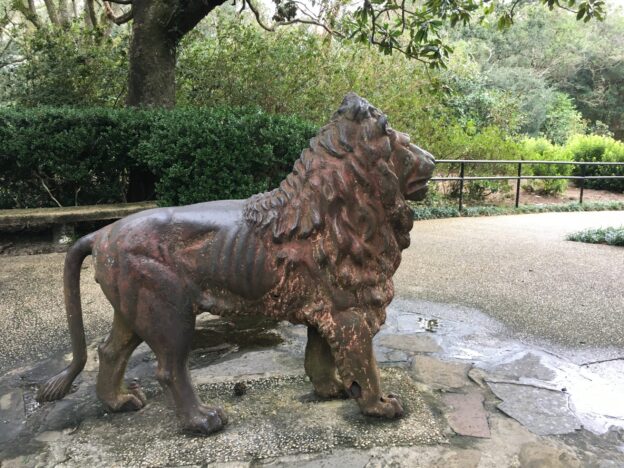
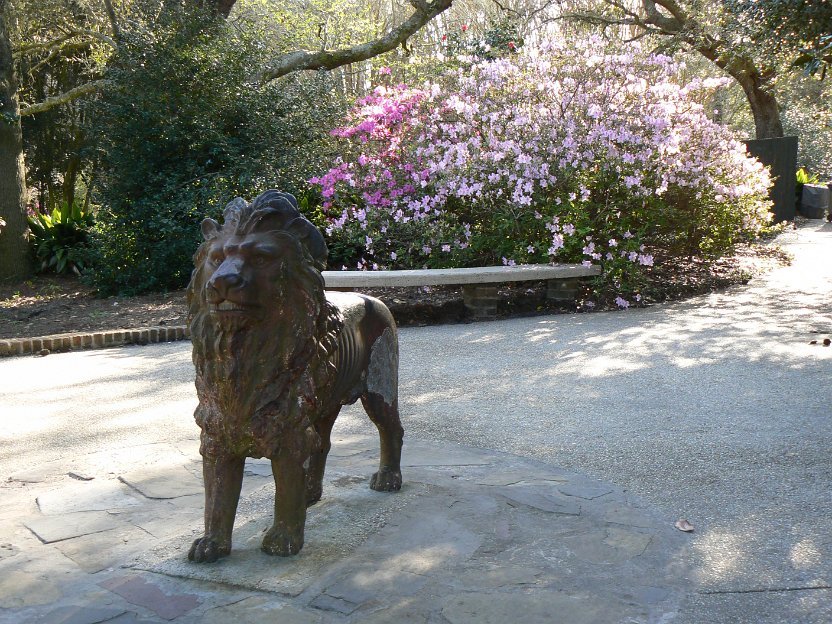
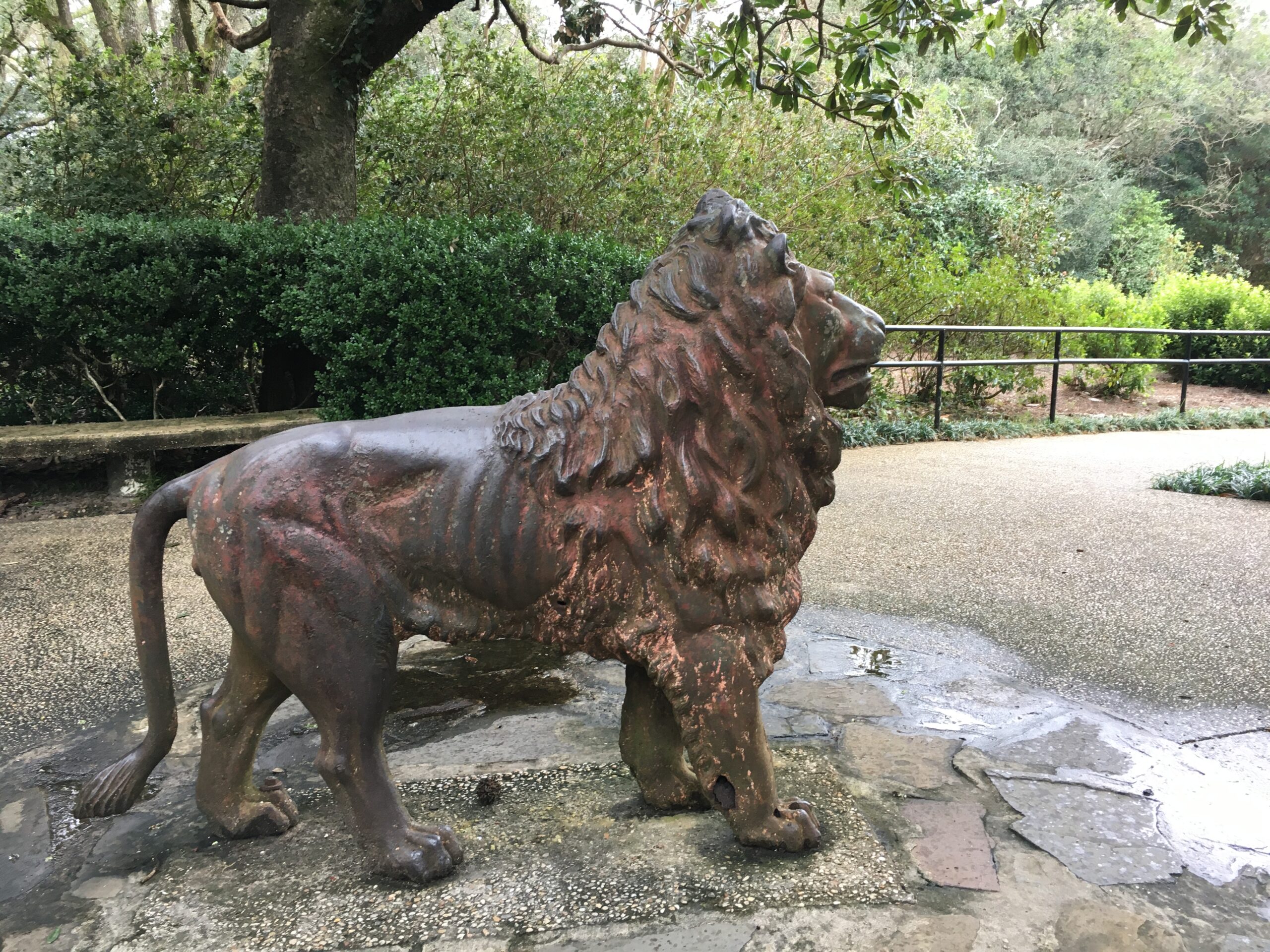
For over 90 years a large cast iron Lion has lived in Bellingrath Gardens. He is always popular with children who enjoy climbing up on his back and no doubt thousands of photographs have been snapped of that scene.
He originally stood in the front yard of Caroline Purvis Marshall (1848-1941) who resided in a handsome home, which still stands at 952 Government Street. Her late husband, John H. Marshall, had been a partner in a wholesale grocery and liquor business with John Bradford Davis.
A nearly identical lion came up for sale a few years ago and was described as having been cast for display at the Philadelphia Centennial celebration of 1876. The maker was Robert Wood & Co., also of Philadelphia. His firm was advertising in Mobile as early as 1852 when a newspaper advertisement offered “Iron railings, Statuary, Greyhounds, Lions, Hat Stands, Tables and Settees.”
A pencil sketch of the Lion by architect George B. Rogers is in the archives of Bellingrath Gardens and Home. It is dated 1931 and so is safe to assume he has resided with us ever since. Before his placement on his own terrace on the west side of Mirror Lake the Lion had stood among the plantings above the Rockery.
Mobile city directories show the Marshalls as residing on Government Street as early as 1877, and no one knows if the lion was there when they moved in or was a later addition. Judge Herndon Inge grew up on that block and recalled the lion as a favorite for neighborhood children. Some things never change.
New ground cloth has been installed next to the greenhouses.
By Dr. F. Todd Lasseigne
Executive Director
To me, one of the joys of visitors coming out to Bellingrath Gardens and Home is that they get to see both the Gardens and the Home as working entities, albeit in differing capacities. From Tom McGehee’s cadre of Home Guides who tell the stories of Walter and Bessie in their home, visitors can feel the “lived experiences” of the Home. In a related capacity, the Horticulture, Maintenance, and Turf & Irrigation staff are hard at work during the weekdays, delivering to our visitors the experience of a “working garden.”
Cleaning the fountains is one of our never-ending tasks.
We are neither the perfect, anesthetized experience of a theme park where all of the dirty work happens after closing time, nor are we an institution that only opens four or five days a week so that major projects can be performed while visitors are not present. Beyond this, of course, are our Café, Visitor Services, and Gift Shop staffs, all of whom work hard to make visitors as comfortable and happy as possible.
All of these facets of BGH conspire to create a never-ending to-do list, the mother of all to-do lists, you could say. Gardens, you may know, are the slowest of the performing arts, and they are never finished, after all. Historic homes, likewise, aren’t known for their lack of maintenance and attention to detail. Since the turn of the New Year, staff at BGH have welcomed thousands of guests, while also working on a great many projects, big and small. From an initial list now numbering over 500 tasks, some 233 of these have been completed. The list never stops growing, of course, just as with our plants.
From the mundane to the major, here are some examples of things we have accomplished. Although we’re happy for you to notice these items, in some ways we feel even better if you didn’t notice them!
1) In early January, we sprayed some of our Dianella (variegated flax-lily) plants with dormant oil because of a scale infestation. Had I just waited to send the work request until late February, the 22° freeze would have taken care of the scale infestation even more quickly because the Dianella foliage was frozen dead and had to be cut back and thrown in the compost pile. Oh well. You win some, you lose some.
Three weeping yaupons were moved from the Admissions Building and replanted on Bellingrath Road.
2) Even today, we’ll still find an occasional hanging branch or two left over from Hurricane Sally. In early January, I saw one stuck in a branch crotch of a live oak and asked a staff member to climb up a ladder to get it. Within an hour, a nice gust of wind had blown it to the ground, negating the need for the ladder. I guess I should’ve been more patient, lol!
3) In early January, we decided to cut down five 20’-tall ‘Savannah’ hollies (two of which were struggling due to lack of light) because Chuck Owens and I noticed that a beautiful large Ginkgo tree behind the hollies was hidden. We were able to remove the hollies by late March, and now the Ginkgo can be viewed and enjoyed.
4) In early February, we had a contractor spade out three large weeping yaupon trees from the front side of the Admissions Building to transplant them to our entrance sign on Bellingrath Road. Two are doing well, but the third specimen is looking rough. We’re in a “wait-and-see” mode on this.
We now have two new fire pits for Magic Christmas in Lights. They were created from an old, unused propane tank.
5) In midwinter, I noticed an old, unused propane tank that was located behind our security building. At first, I thought to have it removed and sent to a metal recycler. However, quick thinking from a couple of staff members resulted in us finding a metalsmith who was able to cut it in half and fashion two new fire pits. You’ll see these at this year’s Magic Christmas in Lights!
6) In early January, I decided that we should relocate the picnic tables on the west side of our parking lot to a new location on the east end of the Great Lawn. This idea came up while we were planning “Beers and Blooms.” Today, these tables are used by our visitors, and we are happy to see visitors traversing the Great Lawn and see the gardens from another angle.
7) Bellingrath appears to have cornered the market on the world’s supply of the green-foliaged version of Aspidistra (cast-iron plant). We decided to remove a patch of it surrounding a sweet gum tree on the back terrace of the Boehm Gallery. Instead of more Aspidistra, visitors can now see more flowers. And who doesn’t want to see more flowers?
8) Our Coca-Cola machines were acting up, sometimes taking people’s coins without dispensing product (how dare they?!), and as such we called and arranged to get new machines, complete with credit card readers, last month. Whoop, whoop!
The sweet gum tree behind the Boehm Gallery is now surrounded with new plantings.
9) Hurricane Sally did quite a number on the ground cloth on our nursery pads where we grow our chrysanthemums and other plants. Chuck worked with our Greenhouse staff to tack down the old cloth, rip out the weeds coming up through the cracks, and install brand-new ground cloth on top. Voila!
10) The three ceiling fans in the Atrium (the small conservatory attached to the Gift Shop) had seen better days such that two were not working in February. Ralph Drury and his Maintenance Department staff procured new fans, and by mid-April installed them such that we now have properly functioning ceiling fans in this area.
Everyone has to-do lists in their lives, gardens, homes, businesses, churches, places where they volunteer, etc. We have ours, too, and it feels great to check them off the list individually virtually every day of the work week! Come and visit us, friends and supporters, and come see the fruits of our daily labors in bringing Bellingrath Gardens and Home to you.
In the 1920s and 1930s, when Bessie Bellingrath wanted to beautify the Fowl River property that we know today as Bellingrath Gardens and Home, she knew that two plants were essential to add color and beauty – azaleas and camellias. She preferred larger, established specimens, and she and her architect, George B. Rogers, found them all over the southeast and had them delivered to the property.
Everyone loves azaleas, but camellias, which are so well-suited to Southern gardens, are sometimes overlooked in the modern-day landscaping world. That’s a shame, because these lovely plants are cold-hardy in our region, nicely shaped and require very little maintenance once they’re established. They can live for many years. Camellias are also versatile; they can be used as hedges, as garden accents, and in containers. Here on the Gulf Coast, many specimens bloom for months at a time. At Bellingrath, we enjoy blooms from a variety of sasanquas and japonicas from November to April.
If you’d like to add camellias to your garden, here are some good resources for finding tried and true varieties:
Laura Kay’s Nursery & Florist, 5600 Cottage Hill Road, Mobile, AL 36609. Phone: (251) 666-1510.
Mobile Botanical Gardens, 5151 Museum Drive, Mobile, AL 36608. (Sales are seasonal.) Phone: (251) 342-0555.
Stokley Garden Express, 1451 Government Street, Mobile, AL 36604. Phone: (251) 461-6434.
Old Tyme Feed and Garden Supply, 19580 S. Greeno Road, Fairhope, AL 36532. Phone: (251) 928-1156. Website: https://www.oldtymefeed.com/
It’s essential to plant it with the root ball slightly higher than ground level, to make sure that the roots will have good drainage.
Water it regularly for the first year, and give it a good soaking whenever the soil seems overly dry.
The best time to plant camellias is either in the spring, or in late fall and early winter.
Camellias do best in dappled sunlight, under a canopy of tall trees.
Newly planted or transplanted camellias should only be lightly fertilized during the first year. Use a slow-release, balanced fertilizer formulated for acid-loving plants, or cottonseed meal.
Add fresh mulch in spring and fall, but not too close to the stems or trunk.
Avoid planting a camellia too close to trees with aggressive surface roots, such as magnolias, oaks and crape myrtles; their roots can invade the camellia’s root zone.
Camellias don’t require frequent pruning, and you should especially avoid pruning after spring, or you’ll likely remove next year’s buds.
Trouble-shooting:
Wilted or discolored leaves: This may indicate a root problem. The roots may be too dry, or overly waterlogged, or may have come in contact with a toxic chemical.
Stunted growth: Have the soil tested to find out if there is an imbalance in the soil minerals or pH level, which may limit the roots’ ability to absorb nutrients for growth.
Disease control: If the foliage wilts in one part of the plant, the cause may be a fungal disease known as “die back.” Try to remove all of the infected wood to prevent it from spreading throughout the entire plant, and treat cut surfaces with a fungicide. Put the infected wood in a plastic bag and discard it to keep the fungal spores from spreading in your garden. Clean your pruning shears with 10% bleach solution between each cut.
The Bellingrath Camellia Legacy
We know that Walter Bellingrath was a camellia aficionado. In a 1947 article, Mr. Bellingrath wrote, “The wonderful forms and colors of Camellia japonica have no equal in the plant world for their beauty and fitness for general landscape work.” He noted that Bellingrath Gardens had more than 2,000 mature specimens of Camellia japonica, which he described as “undoubtedly one of the finest collections of specimen plants to be found anywhere. Over 400 varieties are embraced in this collection.”
After Mrs. Bellingrath died in 1943, Mr. Bellingrath continued their plans for their beloved Gardens until his own death in 1955. His favorite flower was showcased in the Camellia Parterre, which featured 100 specimen plants and was staffed by employees whose job was to remove all spent blooms daily and who were trained to personally identify each variety for visitors, because Mr. Bellingrath disliked the idea of signs marring the natural scene.
The Camellia Arboretum in 1964.
Mr. Bellingrath died two days after his 86th birthday, on August 8, 1955. In the later years of his life, he had often expressed a desire for more and more camellia varieties. After his death, some of his friends had the idea to honor his memory by adding a new camellia arboretum adjoining the original Gardens.
They selected a seven-acre wooded area with good pine tree cover, in the area on the side of Mirror Lake behind the Summer House. In 1957-58, the site was planted with 400 field-grown specimens ranging in age from 5 to 10 years. The gardeners also planted 400 grafting stocks of ‘Professor Sargent’; our guests will notice numerous specimens of this variety at Bellingrath today.
The arboretum eventually featured 1,200 plants of about 900 varieties, situated along grass-covered trails, which were over-seeded with rye grass in winter. Unfortunately, in 1979, the entire garden suffered a direct hit from Hurricane Frederic. The combination of high winds and falling trees wiped out hundreds of camellias and azaleas, including the arboretum. The gardens were closed for six months during the clean-up, which required extensive replanting and rearranging. Many of the arboretum’s prized camellias were salvaged and moved into the main garden. The old ones that survived were nursed back to health by the Gardens’ late manager, Pat Ryan, a leader in the camellia world.
Sources: Camellia Garden Field Guide, Third Edition, by Forrest S. Latta and Brenda C. Litchfield; Bellingrath Gardens and Home archives; The Camellia Club of Mobile
By Sally Pearsall Ericson Director of Marketing and Public Relations
Catie Simpson, the first female to earn her Eagle Scout rank in the Mobile Area Council, built and installed eight bat boxes at Bellingrath Gardens for her Eagle Scout project. The boxes will serve as shelters and nurseries for the tiny flying mammals.
Catie’s project was the first effort to encourage bat habitation in the Gardens, and the Bellingrath staffers are so pleased that Catie selected the Gardens for this initiative. Bats are not only pollinators; they’re also prolific consumers of insects, including mosquitos! In addition, bat guano makes excellent fertilizer. We’re hopeful that the bat boxes will provide shelter for numerous species, including those that are currently endangered.
Catie designed and built the bat boxes with advice from Roger Clay of the Alabama Department of Natural Resources. Her team included 15 volunteers and resulted in 215 service hours.
Here are a few interesting facts about bats that Catie learned during her research:
There are at least 10 different species of bats that range along the Gulf Coast, and 15 statewide.
Bats are not territorial, but they do tend to roost only with their same species.
Bat boxes must be faced at 140 degrees in order to allow for at least seven hours of sunlight.
The color of the paint on the outside of the box is important; a warmer climates requires a lighter color. Catie’s boxes are all painted pale brown.
Bat boxes must be installed within a quarter mile of a fresh water source.
Bat boxes should be mounted on poles instead of on trees to offer additional protection against predators (snakes, owls and hawks).
On average, a bat will consume anywhere from 1,000 to 4,500 insects per night.
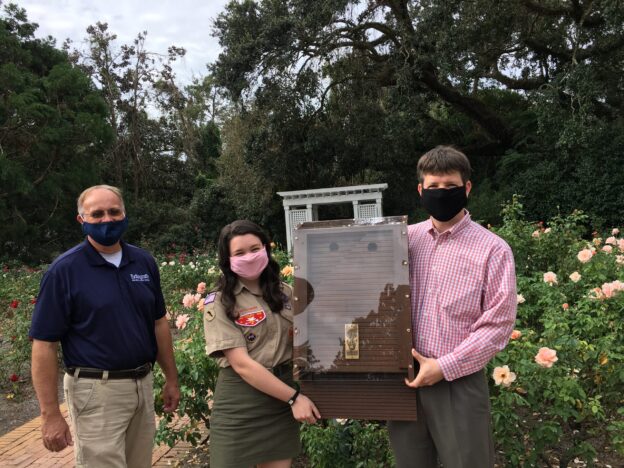
The boxes are 17.5 inches wide and 31 inches tall, with grooved wood at the back and base to make it easy for the bats to get a grip and climb in. The boxes have Ondura corrugated asphalt roofing to shed water, and are mounted at a height of 15 feet. The well-designed structures fit nicely into their surroundings in the Gardens. Catie and her team also built a clear-sided bat box that Bellingrath will use as an educational resource for guests to learn about bats and their habits. This bat box will be placed on display in the Entrance Building.
Catie’s Eagle Scout Court of Honor was held on January 31, 2021, at The Steeple.
Catie, a senior and honor student at Compass Point Christian Academy, is the first female Eagle Scout in the Mobile Area Council of the Boy Scouts of America and the fifth female to achieve the rank in Alabama. Her father and brother are both Eagle Scouts, so she was already familiar with the program when females were allowed to join the Boy Scouts (now Scouts BSA) in February 2019. Catie received her Eagle Scout award in November and celebrated with family and friends at a Court of Honor on January 31, 2021. In a video presentation as part of the ceremony, Ellie Morrison, the first female National Commissioner of the Boy Scouts of America, called Catie “a real trailblazer.”
Catie has volunteered with numerous organizations in addition to Scouts BSA, including the Mobile Museum of Art, Woody’s Song, the Weeks Bay Foundation, the Alabama Animal Welfare Coalition, and AIDS Alabama South. She is an Azalea Trail Maid and a member of the Mobile City-County Youth Council.
Catie and her dad, Charlie, present the educational bat box to Bellingrath Gardens and Home. They are shown with Chuck Owens, Director of Horticulture.
By Sally Pearsall Ericson Director of Marketing and Public Relations
From routine maintenance chores to major repairs, Greg Hill’s work was almost always behind the scenes at Bellingrath Gardens and Home. But his main legacy is Bellingrath’s most well-known and popular season: Magic Christmas in Lights.
Hill, who worked at Bellingrath for 28 years, was one of the show’s creators from the very beginning. In 1995, when Bellingrath’s staff decided to set out a holiday light show unique to the Gardens, Hill was tasked with building the metal frames to hold the lights in place. He had trained as a welder, so he knew what was required. Year by year and piece by piece, Hill built it all, constructing more than 1,100 pieces in total.
Greg Hill with his family (from left): son, Greg Jr.; daughter, Skye; and wife, Susan.
Hill died at age 52, on November 6, 2020, of cancer. At the time of his death, he had recently completed work on a new, 38-piece scene to commemorate the 25th anniversary of Magic Christmas in Lights. The theme was Mardi Gras, in honor of Mobile’s status as “the Mother of Mystics,” the city where Carnival was first held in the United States. The figures included a marching band, a horseback rider, a street barricade and a large replica of a Mardi Gras float, complete with maskers.
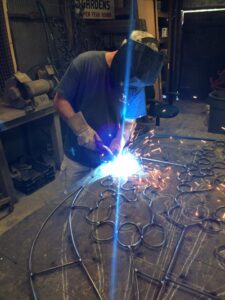
Hill started working on the new scene in May 2020. He designed and welded the pieces in the metal workshop near the greenhouses at Bellingrath. He usually had only a basic drawing to start with, and he used very simple tools. His coworkers marveled at how he could take a small sketch and scale it to a much larger version, often using chalk rubbings on the cement floor of the workshop.
“I always like to think of him as MacGyver,” said Melissa Wells, the Magic Christmas in Lights Manager and Showrunner. “You could hand him anything and he could make it work. … He was so talented, but he didn’t like to boast about his talents.”
Greg Hill used very simple tools to bend and manipulate the metal pieces in the Magic Christmas in Lights scenes.
“After 25 years of welding, he’d really perfected that skill,” said Ralph Drury, Bellingrath’s Maintenance Manager. “If there was one thing that he took a lot of pride in, it was the pieces he created. You could really see the joy he got out of the pieces he created. He wasn’t an egotistic type, but when he talked about them, you could really see that pride – pride that other people enjoyed them.”
“We could hand him a sketch and he could fabricate it in no time,” Wells said. “He had hand-made tools that he used to make it work.”
“Once he started something, he finished it,” said Joey Lulue, another coworker and close friend. “He enjoyed what he did, and he was good at what he did. He had his own way of handling things. He could fix anything – there’s nothing he couldn’t do. … He was the go-to guy here.”
“I pride myself on being a trouble-shooter, and he was a good trouble-shooter too,” said Drury, remembering the huge job that faced the maintenance crew after Hurricane Sally damaged the Under the Sea scenes, one of the most popular sections of Magic Christmas in Lights. “There was so much destruction there, but once we started working on it, we were determined to get it done.”
Greg Hill works on a portion of the Underwater Garden in Magic Christmas in Lights.
In a 2020 interview for the Bellingrath employee newsletter, Hill reflected on the early days of making Magic Christmas in Lights. “We would try to make it bigger each year – we tried to outdo ourselves,” he said. “It was a challenge, trying to figure it out.”
His son, Greg Jr., a radio personality in Austin, Texas, said that some of his earliest memories were related to his dad’s work on the light display. “He would show me how he would just bend the metal any way and all of a sudden just make it into whatever they had planned,” he said. “I just remember every year going there and seeing that my dad did this, you know. I would tell everybody, ‘My dad does that.’ When I started on the radio I would tell people that my dad made all the displays. It was just really fun to brag on him over all the years.”
Hill’s survivors include his wife, Susan, Bellingrath’s Display Horticulture Manager; his daughter, Skye; his son, Greg Jr.; his stepchildren, Aaron, Andrew and Adam Brannon; his mother, Carolyn; and his brothers, Tye and Craig.
To casual acquaintances, Hill was a man of few words. But his colleagues at Bellingrath remember him as a relentless practical joker who loved nothing better than a good stunt, preferably at someone else’s expense.
“He was a real prankster,” Drury said, recalling an incident when Hill decided to hide a dollop of grease on the underside of Drury’s car door handle. “He knew exactly where I was going to put my hand!” (Drury, of course, retaliated as soon as possible.)
“He was always pranking us,” Wells said, smiling at the memory. “If you did something to him, he repaid it.”
“He was quiet to a lot of people, but he could really crack up, laugh, tell jokes,” Lulue said. “A lot of people didn’t see that. … He was very reserved, but if you went out with him after work, he was a cutup.”
“I just remember his dry sense of humor,” said Paula Moore, a tour guide in the Bellingrath Home. “He never seemed angry or upset about anything. He was always in a good mood and cutting up with the guides. … He had a dry humor, dry wit, which was always hilarious to me, because I like a dry wit.”
The Mardi Gras float was one of the last pieces Greg Hill created for the 25th anniversary of Magic Christmas in Lights.
During his off hours, Hill was an avid outdoorsman. He lived in south Mobile County, not far from the Gardens. Sometimes after work, he would return to Bellingrath to relax and fish in Fowl River, just as Walter Bellingrath himself had done, more than 80 years ago.
“He had a real passion for hunting. He enjoyed the outdoors and being in the woods,” Drury said. “We shared a lot of tales about growing up and hunting with our fathers.”
Hill’s art found a new audience during Mardi Gras 2021, when 16 of the anniversary pieces were set up in Mardi Gras Park in downtown Mobile for the public to enjoy. The city did not hold parades during the pandemic because of concerns for public health, but Hill’s colorful creations were a bright spot during the season.
Because of Hill’s private nature, many of his friends and colleagues weren’t aware of the seriousness of his illness. But Magic Christmas in Lights will always be a reminder of his life’s work and creative vision.
“I don’t think people realized the pain he was in,” Lulue said. “He was still coming to work every day.
“Greg did his job. He didn’t seek praise.”
On February 3, 2021, selected pieces from the Mardi Gras scene were temporarily installed in Mardi Gras Park in downtown Mobile in honor of Carnival season.
Winter, from a gardening viewpoint, refers to the time when most plants are dormant. However, gardening in the winter months, and selecting winter-interest plants, is a key part of the Southern gardener’s routine. It is relatively easier physically to garden in cooler weather, and the flowers that bloom in winter tend to last longer, because pigments break down faster at high temperatures than they do in lower temperatures.
Deodar cedar
The southern U.S. is particularly suited for winter gardening because its winters can be characterized as mild but punctuated by cold temperatures. In other words, it’s not consistently cold or frigid for days on end. We do not have to contend with consecutive days where the temperatures are below freezing.
When you’re selecting plants for your winter garden, be sure to consider several factors, including the shape of the plant; when it bears fruit or flowers; the plant’s winter foliage; the colors of the plant’s bark and twigs; and when the plant sheds its foliage.
Plant form: This refers to the shape or overall architecture of a given plant. For example, many conifers are pyramidal, and many live oaks are broad and spreading. Examples include Deodar cedar (Cedrus deodara) and China fir (Cunninghamia lanceolata), which have a pyramidal form; Curly-leaf Ligustrum (Ligustrum japonicum ‘Rotundifolium’), an upright to oval form; and Evergreen Solomon’s seal (Disporopsis perneyi), which has a mounding form with pendent growth tips.
Coralbark Japanese maple
Bark and twigs: The color or texture of bark and twigs can be a defining feature of some plants in the winter. “Twig” refers to the stem growth on a plant from the current year, and sometimes also the prior year. All older growth is just called a “stem.” Twigs often have colored or textured bark that older stems no longer bear. The Coralbark Japanese maple (Acer palmtum ‘Sango Kaku’) is an outstanding cultivar of Japanese maple that bears beautifully colored twigs, reddish-pink to salmon-pink in color. To achieve maximum effect, prune plants back to stimulate more twig growth (even though some people incorrectly assert that you are not “supposed” to prune Japanese maples). Other plants have interesting winter bark, such as Water elm (Planera aquatica), an obscure native tree with gently flaking bark; Parsley haw (or parsley hawthorn) (Crataegus marshallii), a rarely-seen native tree with beautiful smooth bark that exfoliates in jigsaw-puzzle shapes; and the Japanese snowbell (Styrax japonicus), which can bear smooth, sinewy textured bark.
Sacred lily
Winter fruit: Some plants bear fruit that last into the winter. These can be really showy and add color and interest to your garden. Consider planting deciduous hollies such as winterberry (Ilex verticillata cultivars) or possum-haw (Ilex decidua cultivars). The latter is better suited to the Gulf Coast region and is native. Remember that all hollies need a male pollinator plant in order for the female plants to bear fruit. Another good winter-fruiting plant is the Sacred lily (Rohdea japonica), an evergreen groundcover-like plant related to Aspidistra but with showy clusters of orange-red fruits; it’s tough and adapted to the region. A less common selection is the Sweet-box (Sarcococca confusa), a low-growing evergreen shrub with beautiful black fruits and sweetly fragrant flowers. Yaupons (Ilex vomitoria) are a familiar component of southern Alabama woodlands, to the point that they can form thickets. However, female plants do bear attractive fruits, such as the orange-red cultivar called ‘Virginia Dare’. Grow them in your gardens for wildlife value and for ornament.
YauponVariegated loquat
Winter foliage: Not all evergreens are equal, and not all of them have equally attractive foliage. Look for interesting variegated leaves and interestingly shaped leaves. Variegated abelia (Abelia x grandiflora ‘Hopley’s) is one of many variegated abelias that brightens up a shady corner. Variegated Pampas grass (Cortaderia selloana ‘Silver Comet’) is a beautifully variegated version of a common plant. Each leaf is bordered with a white stripe on either side of the long leaf blades, not as noticeable from a distance as when viewed up close, but still beautiful. Variegated curve-leaf yucca (Yucca gloriosa ‘Variegata’) is a beautiful native yucca with evergreen leaves, the center of the leaf blades variegated, and plants often tinging pink in the winter months. Wild-ginger (one of many species of Asarum, incorrectly referred to as Hexastylis by U.S. botanists) is an evergreen groundcover with heart-shaped leaves. It’s also sometimes called “little brown jugs” because of the shape of the unusual flowers. Tree ginseng (Dendropanax trifidus) is a beautiful evergreen shrub with attractive, 3-lobed leaves, perfectly hardy in our climate. Plum-yew (Cephalotaxus harringtonii ‘Prostrata’) is one of several plum-yews that grow so well in the southern U.S.; as an added bonus, they are virtually deer-proof and can tolerate some salt spray.
Swamp Palmetto
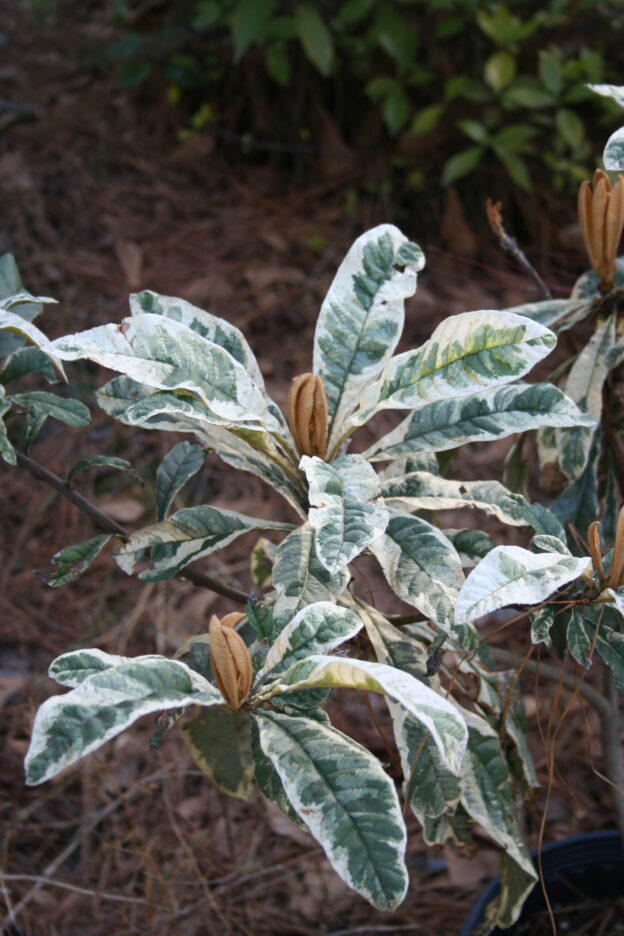
Palm sedge (Carex phyllostachya) is one of a huge plethora of evergreen sedges (many are native, but there are also lots of Asian species with plenty of garden value) that add a unique texture to the winter landscape. Spicebush (Lindera aggregata, formerly known as L. strychnifolia) is one of many Asian species of spicebush, with beautiful teardrop-shaped leaves; unlike the native deciduous species of spicebush we have in Alabama, this one is immune to “laurel wilt” disease. The Swamp palmetto (Sabal minor) is probably taken for granted here because of its commonness in the wild, but it’s a wonderful, stemless palm that bears bold leaves that contrast beautifully when set against fine-textured plants, such as grasses. Hardy cyclamen (Cyclamen coum and others) is a great choice because, unlike the frost-tender florist’s cyclamen you see around Valentine’s Day, this and other species are fully hardy for our region. And if you’re looking for something truly unique, consider the variegated loquat (Eriobotrya japonica ‘Doka’), which was brought back to the U.S. from Japan by several U.S. nursery owners in the 2000s. This plant is still undeservedly rare and features beautiful white-variegated foliage.
Winter flowers: Some plants come into bloom when the temperatures drop and a few mild freezes stimulate them into early flower production. There are many less-commonly known species of camellias that should be tried in our gardens, such as mock-orange camellia (Camellia euryoides) with its small white flowers that dangle underneath the branches. I also like Witch-hazel (Hamamelis species and cultivars); although the Chinese x Japanese hybrid witch-hazels are the best known ones in the nursery and garden world, there is a
Giant pussy willow
relatively recently discovered species (Hamamelis ovalis) that is native to southern Alabama, southern Mississippi, and southeastern Texas that bears much promise as a heat-tolerant and “low-chill” requiring witch-hazel for southern gardens. Stay tuned for more on this plant as Bellingrath acquires clones and begins to trial them in our gardens. The Flowering quince (Chaenomeles cultivars) is a wonderful deciduous shrub I would not garden without, even despite its brief window of bloom; cultivars can be red to red-orange to white to pink. The Winter jasmine (Jasminum nudiflorum) is a deciduous, winter-flowering true jasmine. It’s absent from Gulf Coast gardens but grows readily just barely inland from us, so it’s worth trying for its green twigs in winter, which are bespeckled with bright yellow flowers through the winter months. Hellebores or Lenten roses (Helleborus x hybridus) produce beautiful pink to white to purple-red to yellow to slate-purple flowers in the dead of winter. This hybrid group may not be the best adapted for the Mobile area but should be tried. The “Mediterranean” hellebores are an entirely different group of hybrid hellebores with gray-green, mottled evergreen leaves and gray and purple flowers. The plants in this group of hybrids are native to the Mediterranean area and do not require cold winters in order to bloom or emerge in the next season. Bellingrath needs to do some trial work with these to see which ones will grow in our area. Consider the Hoop-petticoat daffodil (Narcissus bulbocodium and other related species), unusual daffodils from southern Europe, the Mediterranean area, and north Africa. They seem to grow well in the southern U.S. as long as they are given good drainage and sunlight. The Giant pussywillow (Salix “chaenomeloides” or Salix ‘Winter Glory’) is a Japanese pussywillow that bears huge male flowers (catkins), almost 2” long, covered in long, soft hairs. Cut this one back to the ground in late winter after bloom if it gets too large.
EdgeworthiaFragrant wintersweet
Winter flowers that are fragrant are the best of all worlds! Winter honeysuckle (Lonicera fragrantissima) grows as a semi-evergreen plant here, but is deciduous further north. The almost wax-like, small flowers seem like they can’t possibly produce such copious amounts of sweet-scented delight, but they do. The Sweet box (Sarcococca confusa), mentioned earlier for its shiny, black berries in winter, is even better later for the tiny but powerfully sweetly-scented flowers. Japanese andromeda (Pieris japonica) – a wonderful plant related to blueberries, but with sweetly-scented flowers (depends on the cultivar, though, as to how scented). Try the Taiwanese types for better heat tolerance. Fragrant wintersweet (Chimonanthus praecox) is a winter-blooming, large shrub I would not garden without; its flowers can be a vibrant yellow or a dull straw-color, but they are always fragrant in midwinter. For the rest of the year, it is a back-of-the-border plant with no showy aspects. It’s related to our native sweetshrub (Calycanthus floridus), which flowers in spring. Edgeworthia or paper-bush (Edgeworthia chrysantha) is a plant that deserves to be in every southern garden. It is grown as either a mounding shrub or a limbed-up small tree-like shrub, and produces large clusters of white and yellow pendent flowers in winter, sweetly perfuming the garden. The Japanese flowering apricot (Prunus mume cultivars) is a great winter-flowering tree, related to the true apricot of commerce, and also to flowering cherries. The flowers do not open all at once, which means that if a freeze damages or destroys some of the blooms, there are other unopened ones to follow, unlike cherries that tend to flower all at once. Bobby Green has selected a more heat tolerant one (at Mobile Botanical Garden) which does not exhibit “leaf roll,” a symptom of heat stress. It produces pink to white to fuchsia-pink flowers.
Winter daphne
Winter daphne (Daphne odora ‘Aureovariegata’ and ‘Aureovariegata Alba’) is the queen of the winter. This evergreen, low-growing and slow-growing shrub produces terminal clusters of pink or white flowers that will perfume an entire room. It is a finicky grower, often dying for no reason (which I call “sudden daphne death”). Give it good drainage, but do not allow it to dry out, and do not waterlog it. My mom grew it in Thibodaux, La., for years in a container on the back porch near the door into the house. Buy a plant each year, and you’ll never not have it!
Here are some of my recommended online mail-order nurseries:
Nurseries Caroliniana: nurcar.com
Woodlanders Nursery: woodlanders.net
Plant Delights Nursery: plantdelights.com
Manage Consent
To provide the best experiences, we use technologies like cookies to store and/or access device information. Consenting to these technologies will allow us to process data such as browsing behavior or unique IDs on this site. Not consenting or withdrawing consent, may adversely affect certain features and functions.
Functional
Always active
The technical storage or access is strictly necessary for the legitimate purpose of enabling the use of a specific service explicitly requested by the subscriber or user, or for the sole purpose of carrying out the transmission of a communication over an electronic communications network.
Preferences
The technical storage or access is necessary for the legitimate purpose of storing preferences that are not requested by the subscriber or user.
Statistics
The technical storage or access that is used exclusively for statistical purposes.The technical storage or access that is used exclusively for anonymous statistical purposes. Without a subpoena, voluntary compliance on the part of your Internet Service Provider, or additional records from a third party, information stored or retrieved for this purpose alone cannot usually be used to identify you.
Marketing
The technical storage or access is required to create user profiles to send advertising, or to track the user on a website or across several websites for similar marketing purposes.
 Purchase Tickets









 The Bellingrath Camellia Legacy
 By Sally Pearsall Ericson
 Catie designed and built the bat boxes with advice from Roger Clay of the Alabama Department of Natural Resources. Her team included 15 volunteers and resulted in 215 service hours.
 The boxes are 17.5 inches wide and 31 inches tall, with grooved wood at the back and base to make it easy for the bats to get a grip and climb in. The boxes have Ondura corrugated asphalt roofing to shed water, and are mounted at a height of 15 feet. The well-designed structures fit nicely into their surroundings in the Gardens. Catie and her team also built a clear-sided bat box that Bellingrath will use as an educational resource for guests to learn about bats and their habits. This bat box will be placed on display in the Entrance Building.