By Sally Pearsall Ericson Director of Marketing and Public Relations
On July 23, 2020, the Trustees of the Bellingrath Morse Foundation announced that Bellingrath Gardens and Home had hired Dr. F. Todd Lasseigne as Executive Director. Dr. Lasseigne (pronounced “Lah-SANG”) was President and CEO of Tulsa Botanic Garden in Osage County, Oklahoma, a position he had held since 2011. Under his leadership, Tulsa Botanic Garden became a nationally recognized botanical garden.
Dr. Lasseigne, a highly respected horticulturist and public garden leader, holds horticultural degrees from three universities. Early in his career, he was awarded the Martin McLaren Horticultural Scholarship from the Garden Club of America, which he used to study gardens, garden history, plant diversity, plant conservation, and horticulture in the United Kingdom. He has undertaken plant expeditionary work in China, the Republic of Georgia, Mexico, and much of the U.S. He has visited more than 450 gardens during his career.
Dr. Lasseigne has been invited to speak to nursery and public garden professionals in the U.S., the Japanese Nursery Association in Saitama, Japan, and the Seoul Botanic Park in South Korea. He served as the chair of the Plant Collections Professional Section for the American Public Gardens Association from 2008 to 2011, is active in numerous plant societies, and helped organize professional meetings for the Maple Society and the American Public Gardens Association.
“We could not be more pleased to have Todd Lasseigne join us as the new Executive Director at Bellingrath,” said Preston Bolt, Chairman of the Trustees of the Bellingrath Morse Foundation. “Todd’s extensive horticultural background, his tremendous experience at gardens around the country and his obvious appreciation for the history and mission of the Gardens and Home make him an ideal successor to Bill Barrick. We look forward to working with him and the rest of the tremendous staff to make Bellingrath an even more inviting embodiment of the beautiful and historic Gardens and Home that Walter and Bessie Bellingrath left as an enduring legacy to our community, State and region.”
“I am excited and honored to be joining Bellingrath Gardens and Home as the next Executive Director,” Dr. Lasseigne said. “Bellingrath is a beloved institution of national renown, and it is a quintessentially southern garden. It is clear to me that a bright future for Bellingrath lies ahead, building on past excellence and its historical lineage. With decades of beauty, displays, and collections, all set on a magnificent site, the Gardens and Home will continue to grow in importance and value for the citizens of Mobile and southern Alabama, as well as our neighbors to the east and west. I look forward to bringing new eyes and perspectives to this public garden and historic home, coupled with excellence already existing from Bellingrath’s superb board leadership and talented, dedicated, and knowledgeable staff.”
A native of Thibodaux, La., Dr. Lasseigne holds degrees in horticulture from the University of Louisiana at Lafayette, the University of Georgia, and North Carolina State University. Before coming to Tulsa Botanic Garden, Dr. Lasseigne was the founding Executive Director of the Paul J. Ciener Botanical Garden in Kernersville, N.C., and Assistant Director of the JC Raulston Arboretum at North Carolina State University in Raleigh, N.C.
Dr. Lasseigne was selected to replace Dr. William E. Barrick after a national search. Dr. Barrick retired on July 19, 2019, after 20 years at Bellingrath, and was named Executive Director Emeritus.
Dr. Lasseigne is married to Heather Toedt. “Heather and I share a passion for plants, connecting people through plants, gardening, gardens, and landscape architecture,” he said. “When we travel, we look for wildflowers, cool natural areas, beautiful gardens, nurseries and garden centers, and anything horticultural.”
He will begin work at Bellingrath Gardens and Home on September 1, 2020.
Following Mrs. Bellingrath’s death in 1943, Walter Bellingrath hired a local antiques dealer to inventory the contents of his home. Nell Curran had sold Mrs. Bellingrath a number of pieces in the collection and in writing the inventory she added comments about many of these beautiful and unique objects.
But it was not just the fine antiques she inventoried. When she came to the kitchen she listed the contents of all those cabinets, answering the question posed by many of our guests.
Pots and Pans
The list includes saucepans, a pressure cooker, double boilers, pots, several roasters (including three stored in the oven), biscuit pans, cookie pans, pie plates, cake pans (both round and square), a tea kettle, a coffee urn and three coffee pots. Interestingly, the vast majority are described as having been made of aluminum, and in several cases the familiar Wear-Ever brand is mentioned.
A 1930s-era waffle iron, with removable trays.
Wear-Ever aluminum cookware was introduced in 1903 and forever changed the American kitchen. Up until that time cookware was largely cast iron and besides being heavy, it was prone to rust. The use of aluminum changed all of that.
The only cast iron to be found in the kitchen in 1943 was a Dutch oven, a graduated set of frying pans and two pans for cornbread shaped like corn.
In addition to metal cooking implements were some items made of Pyrex glass, including a double boiler, an electric percolator, three mixing bowls in graduating sizes and 28 “individual bakers” or ramekins. Pyrex was created in Corning, New York in 1915 and was used for laboratory equipment as well as kitchenware. Opaque glass was added in the 1930s.
Equipment
There were a number of pieces of kitchen equipment listed, including three meat grinders, a potato ricer, a flour sifter, a churn, a glass rolling pin, two large strainers on stands, a kitchen scale, a pair of ice cream freezers, three electric waffle irons and a Sunbeam Mixmaster. The Mixmaster had been introduced in 1930 and became so popular that it was immortalized on a U.S. postage stamp in 1998.
Also stored in the cabinets were a “leather lunch kit” with two Thermos bottles, six Thermos pitchers with matching trays and “a large Thermos cooler for bottled drinks.” The Thermos brand name has been a household word since being coined in 1903, and derived from the Greek word for heat.
The kitchen scales.
Those Thermos pitchers would have been filled each evening with ice water for the bedrooms in the Bellingrath Home – a reminder that air conditioning had not yet arrived and an electric fan and a glass of ice water made those summer nights more bearable.
Sadly, little of all that kitchenware survives. There is a breadbox, a chrome percolator, a tea kettle, the kitchen scales and a couple of the Thermos pitchers. The remainder of all the items once so necessary for a busy kitchen apparently vanished long ago.
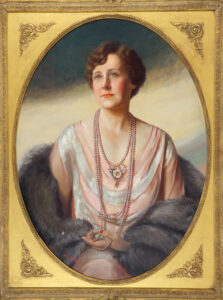
Over the years, it often seems as if far more emphasis has been placed on the life of Walter Bellingrath than that of his wife. The definitive history book for sale in the Bellingrath Gift Shop is called “Mr. Bell,” when a more appropriate title may indeed have been “Mr. and Mrs. Bell,” since the story of Bellingrath Gardens and Home is intertwined with both of their personalities.
Walter Bellingrath set up the Bellingrath Morse Foundation, charging it to maintain his home and its gardens as “a fitting and permanent memorial to my wife,” not himself. Part of the issue may be that he did outlive his wife by a dozen years and during those years he was repeatedly interviewed by news reporters – especially following the announcement of his having created a foundation to keep the Gardens and his home open to the public for future generations.
Bessie Morse Bellingrath was born on May 20, 1878, in Mobile, Ala. She met Walter Bellingrath at some point in 1904 or 1905, when he hired her as his stenographer at his Coca-Cola Bottling Co. in downtown Mobile. The couple were married on November 14, 1906. After 37 years of marriage, Bessie died suddenly on February 15, 1943, at the age of 64, during a vacation to a resort in Hot Springs, Arkansas.
Although relatively little has been written about Miss Bessie, two individuals who knew her well offered some insight into her personality. These stories reflect a warm and very generous person with a good sense of humor.
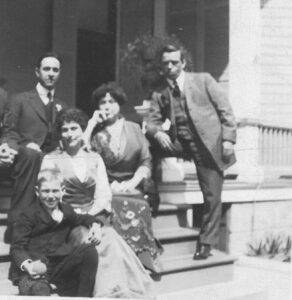
C. Ernest Edgar Jr.. seated in front, is shown with his parents and the Bellingraths circa 1916. From left are Walter Bellingrath, Daisy Morse Edgar, Bessie Bellingrath and C. Ernest Edgar Sr.
A Favorite Nephew
C. Ernest Edgar Jr. was Bessie Morse Bellingrath’s oldest nephew, having been born in 1906. That was the same year she had married Walter Bellingrath. Both the Edgars and the Bellingraths lived on Ann Street, so Ernest grew up underfoot.
After returning to Mobile from Davidson College in North Carolina, Ernest worked for his uncle at the Coca-Cola bottling plant. In 1934, Ernest drove the Bellingraths to the west coast and back with his wife Amelia by his side. It wasn’t long after their return that construction began on the Bellingrath Home, making it necessary to demolish the building which had housed the kitchen and dining room.
One early morning, Ernest said, his aunt called him at work and asked him to come by the Ann Street house. She and architect George B. Rogers needed to go down to the building site and they wanted him to drive. A picnic lunch was being prepared.
Unbeknownst to his aunt, Ernest had a very late night on duty with the National Guard and was exhausted. He called up a couple of friends to ride in the front seat with him and help him stay awake, but none could leave their jobs for the excursion.
The picnic lunch was far more than sandwiches. Containers of fried chicken, gravy, vegetables and all the trimmings were placed on the floorboards of the limousine as Ernest watched. Finally, his aunt and the architect got in the back seat armed with piles of magazine clippings and books with ideas for the new house, and off they went.
As the limousine sped southwards, its driver repeatedly nodded off, and then awoke with a start. Peering into the rear view mirror, he realized his passengers were too busy with their house plans to notice. When they were less than a mile from the gates, Ernest missed the turn into the property and sailed past, sound asleep at the wheel. The car veered into a ditch and fell on its side, cracking an axle.
While no one was injured, the lunch had gone airborne, coating Mrs. Bellingrath and her architect with a warm sampling of the planned meal. As the three stood beside the wreck, who drove up but Walter Bellingrath, who quickly sized up the situation.
“Dammit, Ernest, what have you done now??” Before he could even think what to answer, Bessie Morse Bellingrath spoke up. “Bell, it wasn’t his fault. A covey of quail ran in front of the car and Ernest was trying to avoid them.”
The next day Walter Bellingrath confronted Ernest, who confessed. His uncle’s response: “I knew it. I knew we didn’t have any quail down there.” And not another word was spoken about the incident.
Once the Bellingrath Home was completed, Ernest, Amelia and their young son, Ernest III, were frequent weekend houseguests. On a memorable Friday afternoon Ernest recalled walking in the front door and seeing his son running around the dining room table making airplane noises as he held a sterling silver peacock above his head. After looking around and seeing no sign of his aunt, Ernest, horrified, stepped into the door way and whispered, “Ernest, put that down carefully. Now, you know not to touch Aunt Bessie’s pretty things!” As he stepped into the room, he realized that his aunt was sitting there watching her great nephew.
“That’s all right, Ernest,” she said. “I told him he could play with it. If he breaks it, he breaks it. Don’t worry about it.” And little Ernest revved up his engine and continued his play.
Edward Carl
One of the butlers, the late Edward Carl, recounted going to work for the Bellingraths around 1936 after graduating high school in Mobile. His uncle, Alfred Watson, was the senior butler. Edward said that soon after taking the job, Mrs. Bellingrath asked his assistance in cleaning out a chest of drawers. After wiping out the first drawer, Bessie Bellingrath placed everything back in place, and he put the drawer back in the chest.
He pointed to the next drawer, but Mrs. Bellingrath said, “No, that’s enough for today. I’m getting a little tired. But wait a minute.” And with that, she handed him a folded $20 bill (more than a week’s wages in Depression Era Mobile), with the instruction of “Now, not a word!” That was one of many such gifts she freely handed out, and always with that same admonition.
A while later, she asked him how he was getting to work. Edward explained that he caught a ride with a co-worker who lived nearby. “Now, Edward, you need to be independent and have your own car,” she told him. “Well,” he explained, “I have been saving up and found one I like.” Mrs. Bellingrath asked about the car and the price and said, “I’ll tell you what. Tomorrow when you run my errands to town, stop by the house on Ann Street and Maria will have an envelope for you.”
To his considerable surprise, that envelope contained the full purchase price of the car. Edward later got the vehicle and drove it to the Gardens to show Mrs. Bellingrath. He told her “Now, Miss Bessie, I had saved some money for the car, so I will give that to you and then we can decide on how much to deduct from my pay each week.”
He recalled that without hesitating, she said, “Now Edward, that was not a loan. But … not a word!”
Edward also had a story about a very young Ernest Edgar III who called him “Bub,” since he could not pronounce “Edward.” The little boy was just beginning to talk, and stood among the three butlers in the kitchen, who found to their delight, that he would repeat almost anything said to him – and the words and phrases got saltier by the minute.
As Ernest III tells it, a day or more later he was in his high chair at the lunch table surrounded by adults when there was a lull in the conversation. In a crisp voice he said, “Would someone pass the damn butter?” His poor mother was aghast. “Where on earth did you learn that??” His grinning response: “Bub!”
Mr. Bellingrath went into the kitchen and told the men that the boy would learn that sort of thing in his own time and to cut it out. And what was his wife’s response? According to Ernest Edgar Jr., she was having a good laugh.
Edward entered the service during World War II and was overseas when Mrs. Bellingrath passed away in 1943. He recounted how upset he was that no one wrote him the news and that he only found out about it upon his return. Walter Bellingrath begged him to come back to work for him, and in 1955, it was Edward Carl who sat with him daily at the hospital. He had just returned home at about 9:00 p.m. one evening when he got the call that Mr. Bellingrath had died.
We are indeed fortunate to have these memories from two gentlemen who were very close to Mrs. Bellingrath. While we know of the generous prices she paid for antiques – often far more than their value – the perspective of her life from a family member and a trusted employee reveal a very special lady. It is an honor for every employee at Bellingrath Gardens and Home to work towards maintaining her home and beloved gardens as a fitting and permanent memorial to her.
By Tom McGehee Museum Director of the Bellingrath Home
Walter Bellingrath always wanted his guests at his “Belle Camp” retreat to sign in on old hotel-type registers. (The practice continues to this day.) In the 1936 register, an entry written in Mr. Bellingrath’s distinctive hand states: “Our first meal in our new home on the Glorious Fourth of July, 1936: Mr. and Mrs. Walter D. Bellingrath.” No mention is made of the other guests, or of what the meal consisted of, but the date remains a significant one.
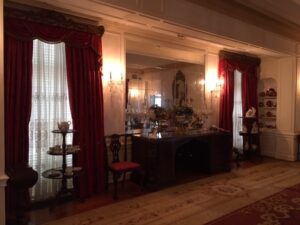
The alcove in the formal Dining Room.
The Bellingrath Home had taken about 18 months to build, amid architect delays and changes to the original design. For example, the alcove in the dining room was an afterthought. It was created after the house was begun, in order to accommodate the recently purchased English sideboard that Mrs. Bellingrath feared might dwarf the room.
Mrs. Bellingrath relied on a Birmingham decorating firm, Hawkins-Israel Co., Inc., for some assistance. The firm was one of the first in the South and offered “one stop shopping” in the 1930s, with departments for design, paint and painting, fabrics, upholstery workrooms, carpets and electric fixtures.
Invoices from Hawkins-Israel offer a fascinating look into the expenses involved in furnishing a great house in the mid-1930s. The carpets and runners came to a grand total of $4,602.24, reminding us today that these were luxury goods in that era. In comparison, the custom-made wooden Venetian blinds installed in every window and French door came to only $891.50. The firm hung all of the mirrors and pictures free of charge.
While the invoices reflect that Hawkins-Israel handled window treatments, carpets, paint colors and even custom-made lamp shades, Bessie Bellingrath handled the rest. During her frequent trips to New Orleans, she found and purchased the dining table and chairs that had once been owned by Sir Thomas Lipton (1850-1931), a 22-piece double parlor suite from a Pontalba apartment, and the sparkling crystal chandeliers for the living and dining rooms.
Mrs. Bellingrath’s bedroom furniture came from a private home on Audubon Boulevard in New Orleans, while the ornate cornices above the French doors in the dining room came from a circa 1856 house on Conception Street in downtown Mobile.
China to fill the Butler’s Pantry came from B. Altman & Company as well as the Black Knight China Company on New York’s Fifth Avenue. The spectacular sterling silver centerpiece for the dining room table came from Royal Antiques in the French Quarter at the hefty price of $475.
The summer of 2020 is a good time to visit the Bellingrath Home and recall that July evening 84 years ago, when an excited couple had the first of many memorable meals in their dream home.
By Tom McGehee Museum Director of the Bellingrath Home
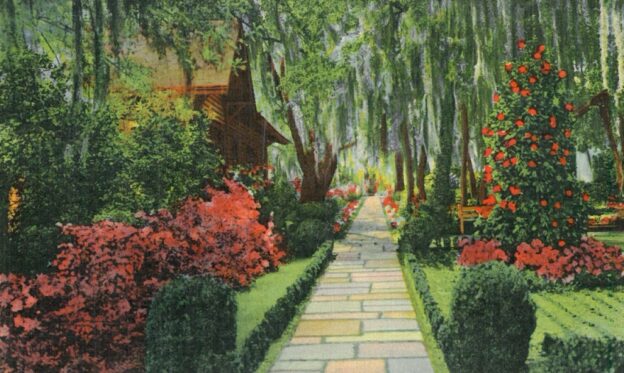
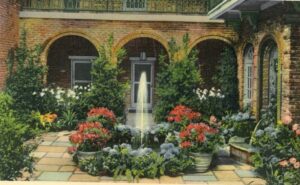
Picture postcards are a 20th-century creation. In 1898, the U.S. Congress passed the Private Mailing Card Act, which allowed private firms, rather than just the Postal Service, to print postcards. Soon after Bellingrath Gardens opened in 1932, postcards made from black and white images were offered for sale at the front gate.
These images were soon joined with colorful “linen cards,” so called for the high rag content, making them look like cloth or linen. Walter Bellingrath Edgar, a great nephew of Bessie Bellingrath and a trustee of the Bellingrath Morse Foundation, recently donated a letter regarding these later, hand-tinted cards. It was written by his uncle, Will Dorgan, to Mrs. Charles Keating of Ohio, who had requested a set of 12 cards depicting the Gardens.
In the letter, dated May 1, 1939, Mr. Dorgan explained that “These cards are made in Switzerland and arrived in New York on March 28th and should have reached us the following week. For some unexplained reason they have been held up in the customs house in New York for inspection and it has been difficult for us to find out just why this unusual delay.”
Before the letter had been mailed, Mr. Dorgan added this P.S.: “Since writing the above the cards have arrived and are inclosed. (sic)”
On the outside of the envelope containing the postcards is a poem written by George B. Rogers, the architect who designed Bellingrath Gardens and Home:
“And thro’ this forest the sunlight stealing,
Kissing the moss and to sight revealing
Wondrous visions of blooming flowers.
Dreams in color, midst leafy bowers.
Camellias, azaleas, and others galore
Compete in harmony. Could you ask more?”
In just four months after that letter was mailed, war would be declared in Europe, and the importation of European goods as well as future orders of those postcards would come to an abrupt halt.
Manage Consent
To provide the best experiences, we use technologies like cookies to store and/or access device information. Consenting to these technologies will allow us to process data such as browsing behavior or unique IDs on this site. Not consenting or withdrawing consent, may adversely affect certain features and functions.
Functional
Always active
The technical storage or access is strictly necessary for the legitimate purpose of enabling the use of a specific service explicitly requested by the subscriber or user, or for the sole purpose of carrying out the transmission of a communication over an electronic communications network.
Preferences
The technical storage or access is necessary for the legitimate purpose of storing preferences that are not requested by the subscriber or user.
Statistics
The technical storage or access that is used exclusively for statistical purposes.The technical storage or access that is used exclusively for anonymous statistical purposes. Without a subpoena, voluntary compliance on the part of your Internet Service Provider, or additional records from a third party, information stored or retrieved for this purpose alone cannot usually be used to identify you.
Marketing
The technical storage or access is required to create user profiles to send advertising, or to track the user on a website or across several websites for similar marketing purposes.
 Purchase Tickets




 By Tom McGehee

 By Tom McGehee
 Invoices from Hawkins-Israel offer a fascinating look into the expenses involved in furnishing a great house in the mid-1930s. The carpets and runners came to a grand total of $4,602.24, reminding us today that these were luxury goods in that era. In comparison, the custom-made wooden Venetian blinds installed in every window and French door came to only $891.50. The firm hung all of the mirrors and pictures free of charge.
 China to fill the Butler’s Pantry came from B. Altman & Company as well as the Black Knight China Company on New York’s Fifth Avenue. The spectacular sterling silver centerpiece for the dining room table came from Royal Antiques in the French Quarter at the hefty price of $475.
 By Tom McGehee
 These images were soon joined with colorful “linen cards,” so called for the high rag content, making them look like cloth or linen. Walter Bellingrath Edgar, a great nephew of Bessie Bellingrath and a trustee of the Bellingrath Morse Foundation, recently donated a letter regarding these later, hand-tinted cards. It was written by his uncle, Will Dorgan, to Mrs. Charles Keating of Ohio, who had requested a set of 12 cards depicting the Gardens.
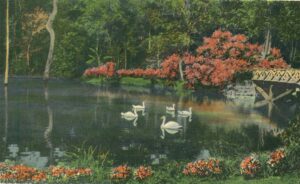 In the letter, dated May 1, 1939, Mr. Dorgan explained that “These cards are made in Switzerland and arrived in New York on March 28th and should have reached us the following week. For some unexplained reason they have been held up in the customs house in New York for inspection and it has been difficult for us to find out just why this unusual delay.”
 On the outside of the envelope containing the postcards is a poem written by George B. Rogers, the architect who designed Bellingrath Gardens and Home: