 Purchase Tickets

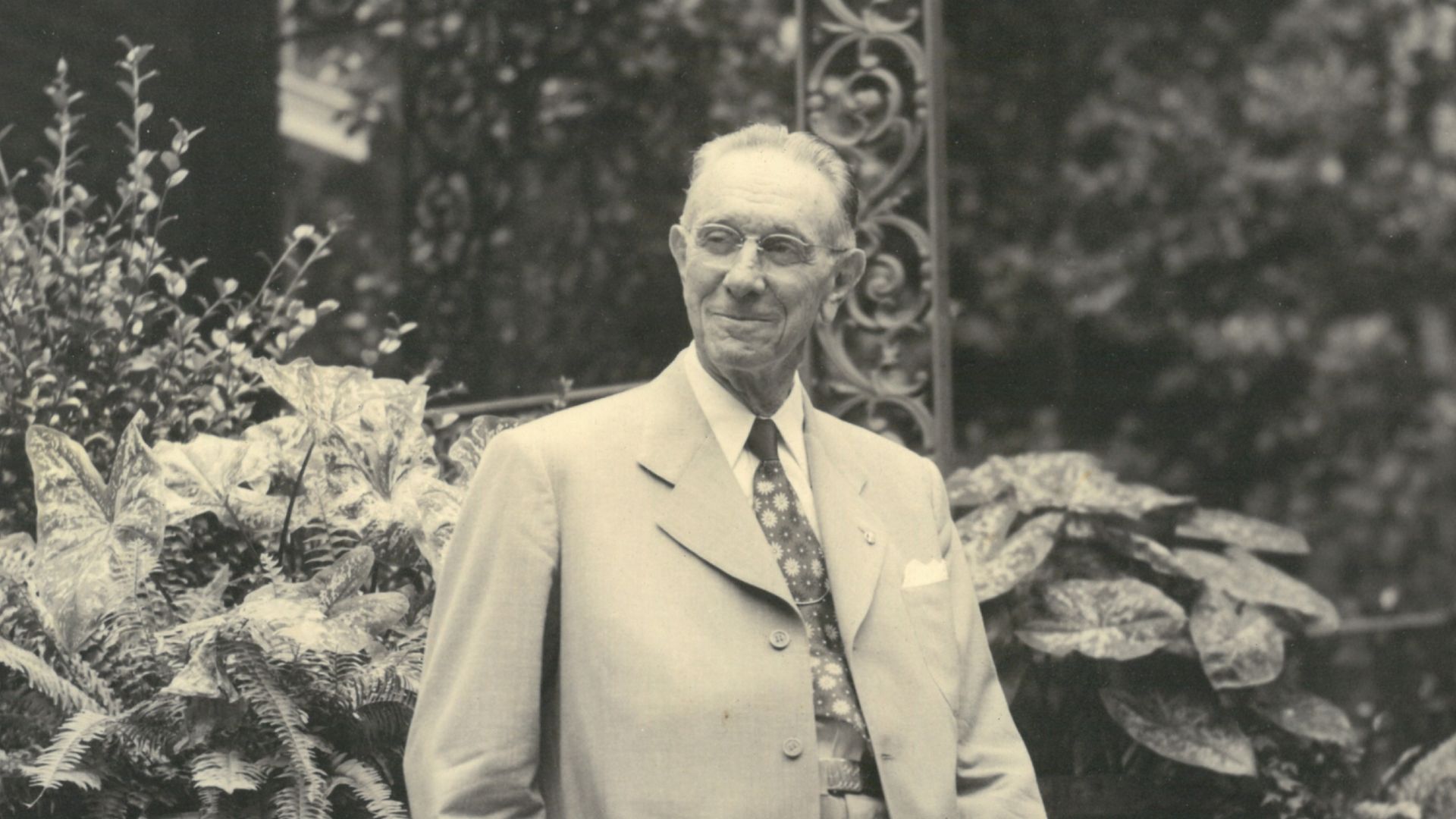
On August 8, we will celebrate Mr. Bellingrath’s birthday. Born in Atlanta in 1869, 157 years ago, his mark and legacy lives on with Bellingrath Gardens & Home, the estate garden that he and his beloved wife, Bessie Morse Bellingrath, created in the first half of the 20th Century. Bellingrath’s own Tom McGehee has written aplenty about Mr. Bellingrath, and I will not attempt to weave a tale as good as Tom could in describing our founder. However, I would like to add some context as to what has been created and why it is so important.
Walter D. Bellingrath is not only our founder, but, of course, he was a Mobile icon – a successful businessman, a community pillar, and an inspirational figure and mentor to so many of his contemporaries. I’ve often said that he was a marketing genius both of his time and ahead of his time. He also was bold in his pursuits, a man who understood the principles of risk (both good and bad), and because of these traits, he was able to excel.
In 1949, Mr. Bellingrath set up the Bellingrath-Morse Foundation, a legal instrument meant to perpetuate the gardens that Bessie Bellingrath had started. In this extraordinary act of generosity in establishing the Foundation so that Bellingrath Gardens would live on past his death, Mr. Bellingrath set in motion something that rarely happens – the creation of something that can give back to its community, through its continuance, for inspiration, mental and spiritual fulfillment, pleasure, and civic-mindedness. That Bellingrath Gardens & Home provides these things, and more, to our visitors, members, and patrons, is a given. But, today’s BGH would not exist were it not for Mr. Bellingrath’s generosity and forward thinking in 1949. And, therefore, in this regard, Walter D. Bellingrath stands among a select group of people who have changed the course of American horticulture, public garden, and historic estate home genres, each in their own cities.
Viewed through this lens, then, here are three peers of Mr. Bellingrath. Please think of these fellow garden/estate founders as being pioneers, just as with Mr. Bellingrath, for their own communities.
1. Henry Shaw of St. Louis, Missouri – Mr. Shaw, who lived well before Walter Bellingrath’s time, was a profitable businessman and community figure in the first half of the 1800s. After visiting prominent English and European gardens through the 1840s, just as with the Bellingraths six decades later, Shaw was inspired to build a country estate and gardens. By 1859, these gardens opened to the public and would later become known as the world-famous Missouri Botanical Garden.
2. Alfred B. Maclay of Tallahassee, Florida – Mr. Maclay, born only two years after Walter Bellingrath, was a successful New York financier and banker. Through visits to Leon County, Florida, where his wife Louise had visited family on many occasions, he fell in love with the area’s trees – oaks, dogwoods, hollies, and pines. This culminated in his creation of a flower garden filled with camellias and azaleas, among other plants. After he died in 1944, Louise and their children donated the gardens to Florida to serve as a memorial to Mr. Maclay and his floral legacy. Today, these are named the Alfred B. Maclay Gardens State Park.
3. Harry P. Leu of Orlando, Florida – Mr. Leu, born 15 years after Mr. Bellingrath, was also a successful businessman and a civic leader in his community. By 1936, he and his wife Mary Jane had purchased property that contained a 1920’s era collection of camellias. By the 1940s, the Leus traveled the world, often returning with new ornamental plants, and especially camellias, to develop their garden. In 1961, they gifted the gardens to the City of Orlando. Today, this is the Harry P. Leu Gardens.
Through this telling of our founder’s significance, and through you reading about other “Walter Bellingraths” of their respective communities, it is my hope that you will never forget the gift of Bellingrath Gardens & Home. Walter D. Bellingrath, through his giving and philanthropy, set up this historic estate garden as a permanent feature of the Mobile community, and also of the greater Gulf Coast region, for generations beyond his time and even beyond ours.