 Purchase Tickets

In 1962, Bellingrath Gardens received our first cuttings of cascading-variety Chrysanthemums from Longwood Gardens in Pennsylvania. These as-yet relatively unknown cultivars were quickly adopted into our display calendar, with our first Cascading Mum Show hitting the scene the very next year. Although this unusual selection of the thoroughly-popular garden variety mum had been in cultivation in the West since at least as early as 1909, their true potential for horticultural display on a mass scale remained elusive in the States for many years. In their native home in Eastern Asia, (namely Japan, China, and Korea) the cultivation of bonsai-type chrysanthemums was already well-developed and much appreciated. The history of mum production in general has spanned over a staggering 3,500 years, beginning as a medicinal and food crop in ancient China. The varieties selectively developed for display in the cascading style (known as kengaizukuri in Japan) originated sometime around 300 years ago, during the long span of relative peace and flourishing artistic movements of Japan’s Edo Period (1603 – 1867).
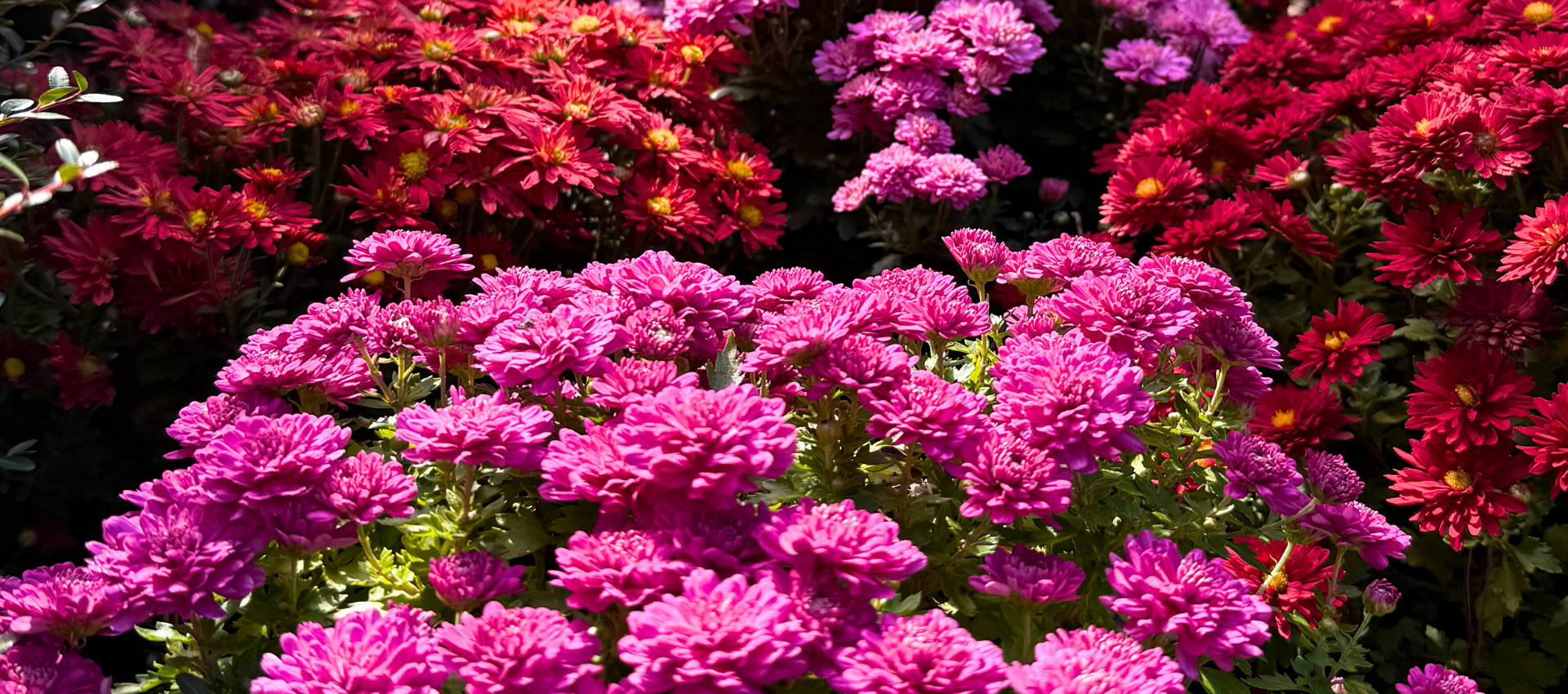
So, what makes a mum variety suitable for training as a cascade? The group of mums chosen for cascades belong to the x morifolium section – the x denotes a hybrid group, and morifolium means “mulberry-leaved”. Mums from this section have delicately incised leaf margins and tend to sport numerous small flowers, as opposed to the singular, massive flowers of other types (think of the substantial globe-like flowers of “football mums,” popular in decades past). Cascading mums are essentially being pruned into bonsai (kiku no bonsai, literally “bonsai of chrysanthemum,” is the name for the Japanese practice of training mums into unique shapes), so our mums must have the qualities which make for successful bonsai subjects. These qualities include having supple new growth which develops a woody base, having a generously branching habit, and long internodal lengths – spaces between branches along the stem – all of which allow us to cultivate our mums from cuttings only inches long into draping tapestries of flowers several feet in length.
It may be surprising, but our mum “season” actually spans nearly a full year. We begin as soon as the previous show ends, with visions of display designs, lists of figures, calendars, and spreadsheets. In January, each stock plant of our 35 cascading varieties is evaluated by our Display Designer and Nursery team, working in tandem to assess the number of viable cuttings which can be taken from each mother plant. Cuttings taken are selected by hand for length, growth habit (cuttings which exhibit excessive “crowning” or branching of tip shoots are discarded, as are those without ideal internodal length), as well as general health and vigor. This past year, we stuck over 5,000 cuttings to prepare for our seasonal display.
Like many plants with a highly seasonal flowering period, chrysanthemums schedule their blooms according to the day length – or, more accurately, they sense the hours of darkness between each period of available sunlight using a sophisticated system of hormonal regulation. For this reason, they are known as “long night” plants – when the period of darkness exceeds about 12 hours and 40 minutes, the bundle of cells at their shoot tips will begin differentiating, becoming the types of cells which will form flowers. Temperature plays a supporting role in coordinating bloom time as well, with cooler temps bolstering fuller blooms and warmer temps impeding consistent flowering.
Our cuttings are potted up according to the agreed upon display quantities for bedding mums, towers, pyramids, and cascades, and grown out in greenhouse conditions until May. During that time, each cutting is being fastidiously trimmed, pinched, pruned, staked, tied, and twisted, all to achieve the desired shape for each design. Our new plants also receive a regimen of specially-chosen fertilizers and PGRs (plant growth regulators, a class of chemicals consisting of both naturally-derived plant hormones and synthetic compounds which help control plant growth) to achieve the correct balance of stem length and full, compact flowering shoots. In June, we begin tying our mums to the cascade racks, carefully training them to grow upside-down, and onto upright metal forms to become the columns and pyramids displayed around the Gardens.
From summer to late fall, the mums receive additional training and treatments to continue shaping and bulking up on blooms. By mid-October, depending on the temperatures of any given year, the mums will begin making their way to the Gardens for installation. Their flowering period lasts only a handful of weeks, but because we use a blend of many different heirloom varieties, we’re able to spread that bloom season out to its fullest extent. After they finish their fantastic show and are ceremoniously decommissioned and transported back to the Nursery compost, planning has already begun for the next year. Our cascading chrysanthemums are a huge investment of time, labor, and love – a ten-month crop for a four-week show – but they’re also a beautiful and poignant farewell to the long, riotous days of the summer garden and a cheerful welcome to the tranquility of winter at Bellingrath.